Whistleblowing can expose serious problems within a business.
Allegations may involve fraud, financial misconduct, corruption, theft, regulatory breaches, or serious workplace wrongdoing.
For an employer, receiving a whistleblowing report creates an immediate challenge.
The allegation must be taken seriously. However, assumptions should not be made about either the whistleblower or the person accused.
An independent whistleblowing investigation can help establish what happened and identify the available evidence.
At Corporate Investigations, our dedicated UK team conducts discreet and professional corporate investigations.
Our Director is a member of the Institute of Professional Investigators (IPI). We have over 15 years of professional investigation experience.
What Is Whistleblowing?
Whistleblowing occurs when a worker reports certain types of wrongdoing connected with their work.
Under UK law, specific disclosures may qualify for legal protection.
Protected disclosures can concern matters such as criminal offences, breaches of legal obligations, dangers to health and safety, or environmental damage.
They can also concern miscarriages of justice or attempts to conceal relevant wrongdoing.
Not every workplace complaint will qualify as whistleblowing.
Businesses should therefore consider appropriate HR or legal advice when assessing a disclosure.
What Should a Business Do After Receiving a Whistleblowing Report?
The first response can be critical.
Avoid reaching conclusions before the available evidence has been examined.
Businesses should consider protecting relevant documents, emails, records, CCTV, digital information, and other potential evidence.
Access to sensitive information may also need careful control.
The organisation should then establish who is suitable to conduct the investigation.
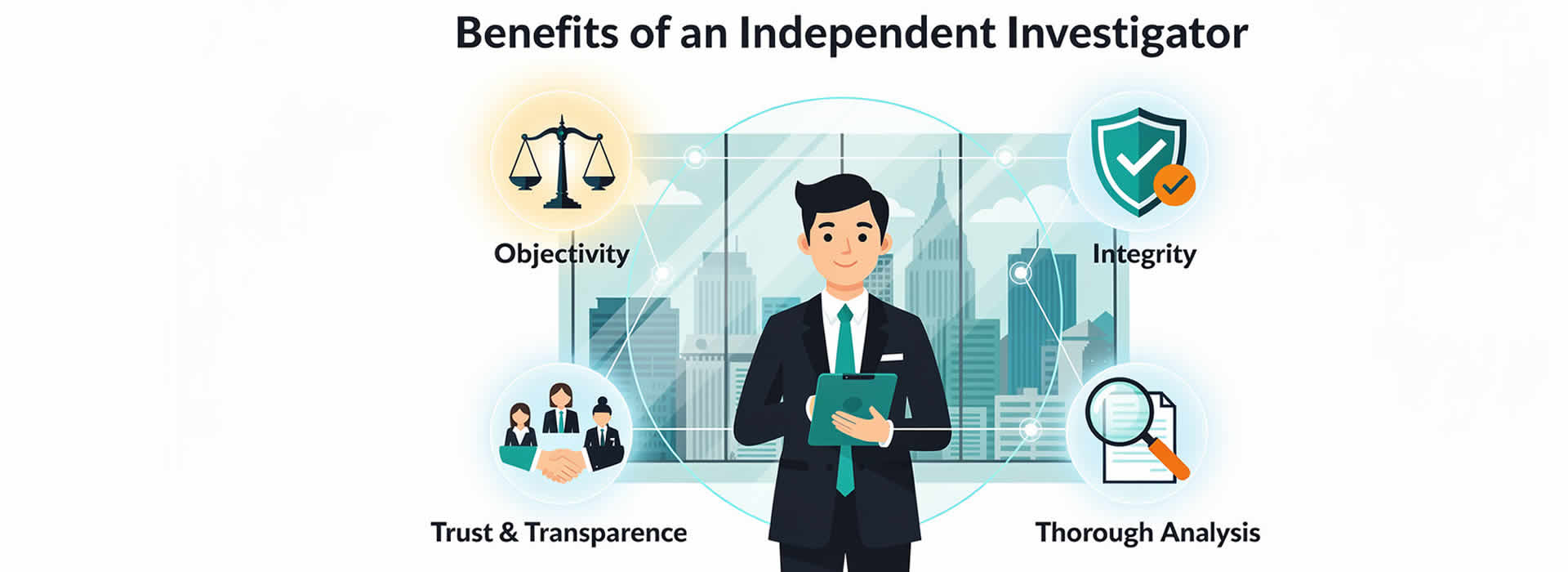
Why Use an Independent Investigator?
Some whistleblowing allegations can be investigated internally.
However, independence becomes particularly important when allegations concern senior management, directors, finance teams, or other influential individuals.
An internal investigator may have existing professional relationships with the people involved.
Even where no actual bias exists, questions about independence can arise.
An external investigator provides greater separation from internal relationships and management structures.
Establish the Facts, Not a Predetermined Outcome
A whistleblowing investigation should not start by assuming that an allegation is true or false.
Its purpose is to establish the relevant facts.
An investigator may examine documents, interview witnesses, review records, and compare different accounts.
Evidence may support an allegation. It may contradict it. Sometimes, the available evidence remains inconclusive.
An independent investigation should report what the evidence establishes.
Evidence to a Court Standard
Evidence handling can become important when a whistleblowing allegation leads to disciplinary, regulatory, civil, or criminal proceedings.
Relevant material should be identified, obtained, documented, and preserved carefully.
At Corporate Investigations, we focus on gathering and documenting Evidence to a Court Standard, where appropriate.
This provides a structured evidential record for the client and their professional advisers.
Protecting Potential Evidence
Evidence can disappear quickly.
Emails can be deleted. Documents may be altered. CCTV can be overwritten. Witness memories can also become less reliable over time.
Businesses should consider preservation measures as soon as a serious allegation is received.
An investigator can help identify potential sources of evidence and establish an appropriate investigation strategy.
Interviewing Whistleblowers and Witnesses
Interviews can form an important part of a whistleblowing investigation.
The whistleblower may hold information that does not appear within the initial report.
Other employees may also have relevant knowledge.
Interviews should be planned carefully and documented accurately.
Investigators can then compare witness accounts with documents and other available evidence.
Investigating Allegations Against Senior Employees
Whistleblowing becomes particularly sensitive when allegations concern directors or senior management.
Normal reporting structures may create conflicts of interest.
Employees may also be reluctant to speak openly to somebody within the organisation.
In suitable circumstances, an external investigator can provide a more independent route for gathering evidence and interviewing relevant people.
Confidentiality During a Whistleblowing Investigation
Confidentiality should be handled carefully.
Information should normally be limited to people who genuinely need access to it.
However, businesses should avoid promising absolute confidentiality where this cannot be guaranteed.
Legal proceedings, regulatory obligations, or the requirements of a fair investigation may affect what information must be disclosed.
Common Whistleblowing Allegations
Corporate Investigations can assist with enquiries concerning allegations such as:
- Fraud and financial irregularities
- Theft and misappropriation
- Bribery or corruption concerns
- Undisclosed conflicts of interest
- Procurement irregularities
- False expenses or financial records
- Serious employee misconduct
- Misuse of company information or assets
- Regulatory concerns
- Attempts to conceal suspected wrongdoing
Every allegation is different. The investigation should therefore be proportionate to the circumstances and potential risks.
Avoid Common Investigation Mistakes
A poorly managed investigation can create further problems.
Confronting a suspected individual too early may place evidence at risk.
Allowing employees to discuss allegations widely can also affect witness evidence.
Another common problem is approaching an investigation with a predetermined conclusion.
A structured investigation plan can reduce these risks.
What Does an Independent Whistleblowing Investigation Include?
The precise investigation will depend on the allegations.
We can review the initial disclosure and identify the questions requiring investigation.
A Clear and Professional Investigation Report
Decision-makers need to understand both the findings and the evidence supporting them.
Our reports can document the enquiries undertaken and relevant evidence obtained.
They can also identify inconsistencies, supporting information, and areas where evidence remains unavailable.
The purpose is to provide a factual record which assists informed decision-making.
UK Whistleblowing Law
Whistleblowing has specific legal protections within the UK.
The Public Interest Disclosure Act 1998 amended the Employment Rights Act 1996 to provide protections for qualifying workers making certain protected disclosures.
Whether a particular disclosure receives statutory protection depends on the facts and applicable legal requirements.
Employers should obtain specialist employment law advice where necessary.
An investigator establishes facts and evidence. Legal advisers can determine how those findings affect the organisation’s legal position.
Why Choose Corporate Investigations?
Corporate Investigations provides independent corporate investigation services throughout the UK.
Our Director is a member of the Institute of Professional Investigators (IPI).
Our dedicated UK team has over 15 years of professional investigation experience.
We understand the sensitivity surrounding whistleblowers, employees, directors, and serious allegations.
Our investigations focus on independence, discretion, factual reporting, and Evidence to a Court Standard.
Free 30-Minute Consultation
Have you received a whistleblowing allegation within your organisation?
Early action can help preserve evidence and establish an appropriate investigation strategy.
Corporate Investigations offers a Free 30-Minute Consultation to discuss your situation in confidence.
Call 0800 334 5440 to speak with our dedicated UK team.